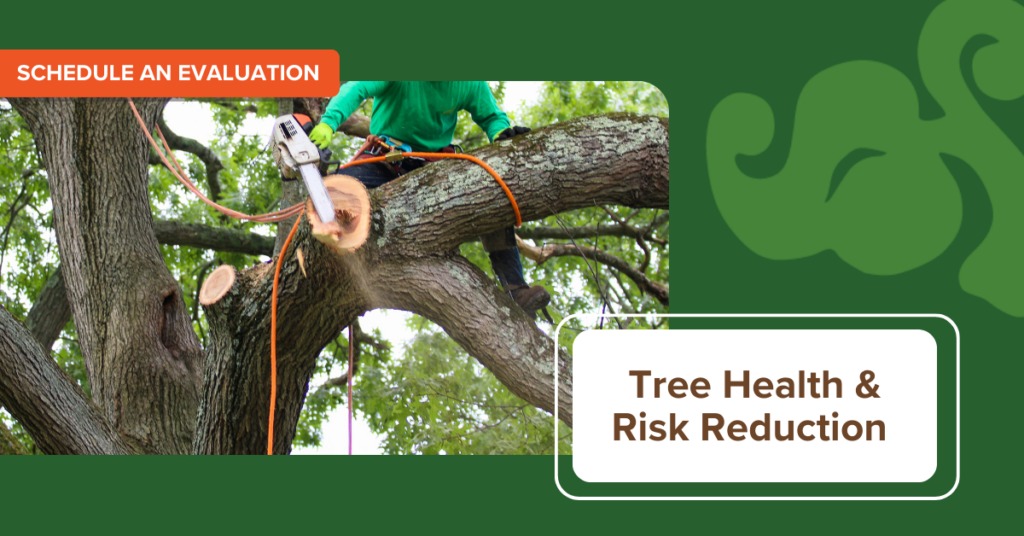
Trees add beauty, shade, and value to your property, but they can also become a serious liability if they’re not properly maintained. A failing tree can impact pedestrians, vehicles, neighboring properties, and utility lines. For commercial property owners, unmanaged trees can also create liability issues and disrupt operations.
First Step: Give Your Trees a Checkup
A tree can appear healthy on the outside while hiding issues on the inside. Disease, decay, root damage, and stress from environmental changes can weaken a tree before symptoms become visible. It can be a challenge for homeowners to know what to look for–and when it’s time to call in a pro, but regular inspections can help identify potential risks early, when intervention is simpler, safer, and less costly.
Professional tree health assessments look at factors like:
- Overall canopy fullness and leaf health
- Signs of disease, pests, or decay
- Structural integrity of the trunk and branches
- Root system stability and soil conditions
- Growth patterns and past pruning history
Storm Safety: Risk Reduction
Storms are inevitable in New England. High winds, heavy snow, ice, and oversaturated soil can turn a weakened tree into a liability overnight. Any of these signs is a strong reason to have a certified arborist assess your tree:
- Trees with large dead or dying branches
- Leaning trees or trees with compromised root systems
- Trees with cracks, cavities, or splitting trunks
- Overgrown limbs near buildings, vehicles, roads, or power lines
- Trees affected by previous storm damage
Pruning vs. Removal
Not every struggling tree needs to be taken down. Often, targeted pruning and care can restore your tree’s health. The key is making decisions based on long-term health and safety, not just short-term appearance.
Pruning and preservation are recommended when:
- Only a few branches are dead or damaged, and the trunk and root flare look solid
- The tree has good structure, but needs thinning to reduce density and wind sail
- Issues are mostly cosmetic, like minor dieback
- Branches are encroaching on structures or utilities
- A tree needs improved airflow, water penetration, sun exposure
Removal may be necessary when:
- More than half the canopy is dead or declining
- The tree is severely diseased or decayed
- Structural integrity is compromised
- The tree poses a risk to your home, driveway, or power lines
- Root damage is visible (heaving soil, exposed roots)
Proactive Long-Term Tree Care
Knowing when a tree needs maintenance or removal comes down to understanding its health, structure, and surroundings. While some warning signs are easy to spot, others require an expert. Whether you’re caring for a residential landscape or a commercial property, proactive tree assessments can help prevent costly emergencies and protect your investment.
The certified tree service professionals at Piscataqua Landscaping & Tree Service know how to distinguish between trees that just need some care and those that truly need to come down–for your safety and your property’s long-term health. Our team has the equipment and expertise to ensure your trees are healthy and thriving for years to come.
Get in touch to schedule an evaluation today.